Camera-Ready Instructions
For papers accepted to the IJCKG 2026 CEUR-WS proceedings — that is, the Poster and Demo Track and the workshops only. Prepare one ZIP archive containing the final PDF, the source file, and a signed author agreement, then upload it to EasyChair.
- Poster and Demo Track
- RDM-KG 2026 — Workshop on Research Data Management for Knowledge Graphs
- KGE-LLM 2026 — International Workshop on Knowledge Graph Engineering in the Era of Large Language Models
Published via CEUR-WS.org · CEURART template
The CEUR-WS volume accepts source files in LaTeX or ODT format. Microsoft Word (.doc / .docx) is not a submission format.
Word can save a document as ODT, but authors should carefully recheck the resulting ODT and
PDF for formatting or compatibility issues.
One ZIP archive, three files.
Please prepare one ZIP archive containing the three required files below and upload it to
EasyChair. Use your assigned Paper ID consistently when naming the files.
Do not upload LaTeX source files individually — package them all in Paper-ID-source.zip.
IJCKG2026-Paper-49.zip
├── Paper-49.pdf
├── Paper-49.odt
└── Agreement-49.pdf
IJCKG2026-Paper-49.zip
├── Paper-49.pdf
├── Paper-49-source.zip
└── Agreement-49.pdf
The PDF must be generated from the submitted source.
2.1 · Length
2.2 · CEUR-WS Formatting
The paper should follow the one-column CEUR-WS format and use only the Libertinus font family. The first page should contain the CEUR-WS copyright and conference information in the footer.
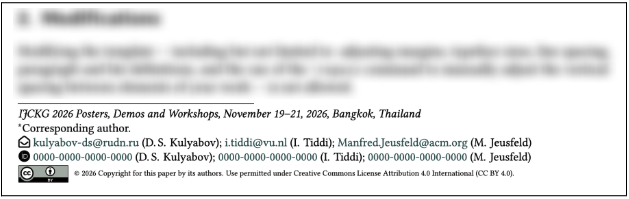
For LaTeX submissions, include the following in the document preamble:
\copyrightyear{2026}
\copyrightclause{Copyright for this paper by its authors. Use
permitted under Creative Commons License Attribution 4.0 International
(CC BY 4.0).}
\conference{IJCKG 2026 Posters, Demos and Workshops, November 19--21, 2026, Bangkok, Thailand} 2.3 · Declaration on Generative AI
According to the CEUR-WS instructions, all papers must include a section entitled “Declaration on Generative AI” in accordance with the CEUR-WS Generative AI Policy. The declaration should describe the use of generative AI in the preparation of the paper. For example:
Declaration on Generative AIDuring the preparation of this work, the authors used [name of generative AI tool] for [briefly describe the purpose, e.g., language editing, grammar correction, translation, or assistance with drafting]. The authors reviewed and revised the resulting content and took full responsibility for the final content of the paper.
Declaration on Generative AIThe authors did not use any generative AI tools in the preparation of this work.
These examples are provided for guidance only. Authors should adapt the declaration to accurately describe how generative AI was actually used in their work, and ensure that it complies with the current CEUR-WS Generative AI Policy.
The source must reproduce the submitted PDF.
3.1 · LaTeX Preferred
Place all files required to compile the paper into Paper-ID-source.zip —
LaTeX sources, bibliography files, figures, and anything else needed to reproduce the
final PDF. The source should compile to the same PDF submitted as Paper-ID.pdf.
3.2 · ODT
Authors who do not use LaTeX may submit their source in .odt format, the
OpenDocument Text format. LibreOffice or Apache OpenOffice can be used to create and edit
ODT documents.
Microsoft Word can also save documents in ODT format. However, differences in how
applications handle document formatting may result in layout or formatting
incompatibilities. Authors using Word are advised to carefully recheck the resulting ODT
document and final PDF — particularly the page layout, fonts, figures, tables, and other
formatting elements. The submitted ODT file should correspond to the final PDF uploaded
as Paper-ID.pdf.
Print, sign by pen, and scan.
Complete the appropriate CEUR-WS author agreement, print it, sign it physically with a pen,
and scan the completed document as a PDF. Digital signatures are not accepted. Save the scanned agreement as Agreement-ID.pdf.
Before you upload.
- The ZIP archive contains exactly the required files.
- The Paper ID is used consistently in all file names.
- The PDF and source file correspond to the same final version.
- The paper follows the page limit for its track — 5–9 pages for Poster and Demo, 10–16 pages for workshop papers.
- The one-column CEUR-WS format and Libertinus font are used.
- The required first-page footer is present.
- The “Declaration on Generative AI” is included.
- The author agreement has been completed and physically signed.
Questions about the camera-ready process? Contact ijckg-2026@aiat.or.th.